
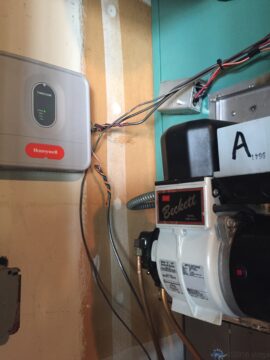
In May 2018, we started the very large project of decommissioning our twin diesel furnaces. Even though we had nursed them through two winters, cleaned and repaired the ductwork, and replaced the original return vents with filtered ones, we weren’t especially happy with the smell of burning dust and debris every time the giant engines roared–and I mean roared–into action. I thought I had a video of when one of them would fire up, but haven’t been able to find it; here are some pics instead.

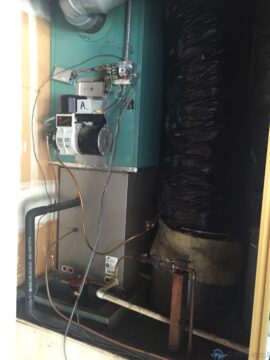
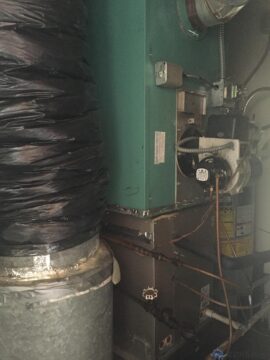

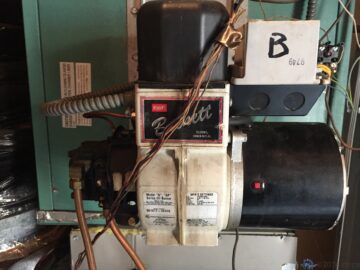
The furnaces were big Becketts, manufactured in Ohio and original to the house. Amusingly enough, the same brand once sat in the garage/utility area of one of my grandparents’ houses when I was growing up, and it also was big, green and loud.
The two units worked independently of one another. One handled the north end of the house, but not the great room and foyer; the other handled the south end including the great room and foyer. While the thermostat for the north end was located logically the north hallway, the thermostat for the south side was on a wall in the great room. Considering the great room is a giant box measuring 26′ x 26′ x 24′, heating it is not really possible even with 8 vents and two returns, and since two sides of the space are glass, it tends to heat up quite well during the day just from all the sun exposure.
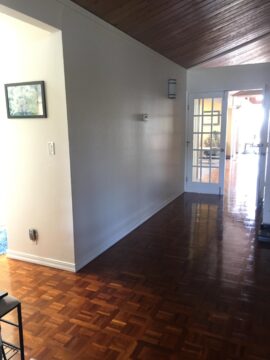
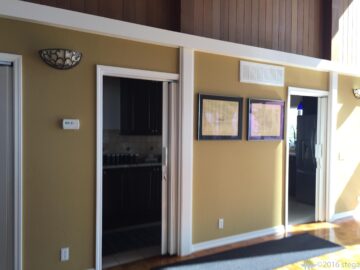
For two winters we experimented with closing the doors between the great room and kitchen if and when we wanted to heat that side of the house. We soon learned it’s rarely necessary, as the windows in the kitchen all face south and even on the coldest and cloudiest days, enough sunlight is available to warm up the space nicely, and running the north-side furnace was actually more than enough to keep Agent Smith’s office pretty snug in cold weather. This is because the furnaces sat in a very large closet within in office, and when the furnaces fired up, the sliding mirrored doors on that closet would rattle about, so we invested in some simple felted sealing tape which stopped the rattling and helped keep the diesel smell almost at bay.
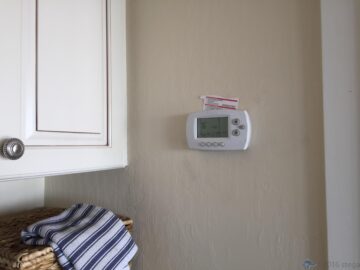
In 2016 we also moved the thermostat for the south furnace. We had a random furnace person do the work based on the advice of the last diesel furnace specialist, whom I would have had handle it as that would have much smoother and NOT required a return visit because he would have known exactly what to do. But he is very expensive, and that’s part of home ownership–learning which contractors not to use is even more important than finding great ones. Anyway, we put the furnace remote in the laundry area.
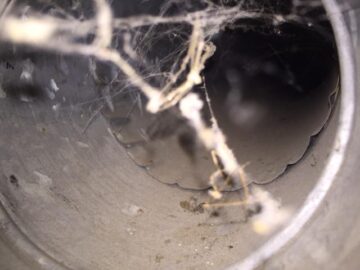
In the 1990s, the POs had whole-house A/C installed, so they jacked up the furnace air exchangers and slammed in some condenser units underneath them. This left absolutely no room for air filters–zilch, zip, nada. So not only did we have 50-year-old ductwork that the POs never bothered to clean (see image below), we also had no way to even try to filter out crap, so the furnaces just kept blowing dust and debris through the house again and again. I’m pretty sure this is why, when we moved in, we discovered the thermostats were set to only fire the furnaces up for a few hours in the mornings and evenings, and then only to about 62 degrees Fahrenheit. I guess they were content to be cold and not breathing dust instead of spending a bit of money on being warm.
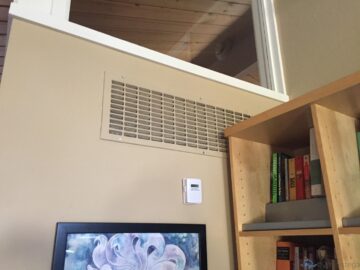
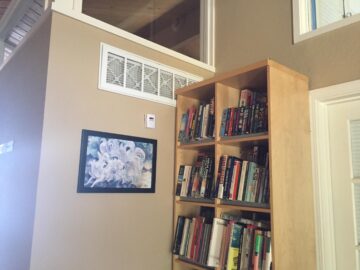
In 2016, we also invested in new return vents that could hold filters. You’ll notice that the POs just painted the old vents when they had the walls painted. They didn’t even bother to remove them from the walls, and just slopped paint over them.

Long story short: our first two winters here, the boys had respiratory issues and the smell of diesel permeating Agent Smith’s office (originally the garage, converted into a furnished space in the mid-80s) was very pungent. So we did some online research, I made a few calls, and in May 2018, we got to work.