
As most of the world knows, much of California is currently on fire. Right now, the Purgatory area is currently beset with wildfires started by lightning strikes that occurred a week ago. Thankfully we’re all safe, and right now it appears we may be out of danger. Fortuitously, last February we finally purchased an RV that met our weird and various needs, and she has come in quite handy. Here’s Midge, a 2007 Earthroamer. It’s a fitting name since she is a Ford, and our F150 is named Barbie.
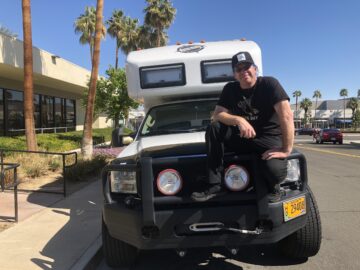

It took several years of looking at RV listings online, as we wanted something similar to the cute little Toyota Hylux (below) we rented and drove from Adelaide to Darwin the year before we bought this place.


But in the years of searching we digressed, as our needs for an RV were a bit non-traditional. While it is just the two of us (Agent Smith and myself), we wanted to be able to travel with the boys (who, by the way, have their very own Instagram account in case you weren’t aware). We also wanted an RV that could tow our race cars. (Yeah, you read that right–we now have several, but more about that in a future post.) Over the years of searching our–well, mainly Agent Smith’s–search net morphed into various forms. For a while he thought a big diesel pusher or converted Bluebird school bus would be adequate, but getting something that large up our narrow and winding roads could be an issue. Finally we narrowed things down a bit, and went back to smaller options. Last February, we found a suitable option for sale in Palm Springs and made the journey to see it. While a bit rough, and reeking of sandalwood, we deemed it suitable and bought it.
As I said, we made the journey–all four of us, to Palm Springs, in the Carrera. I tried out a new travel option for the boys: a single carrier with a divider to keep them from bickering.
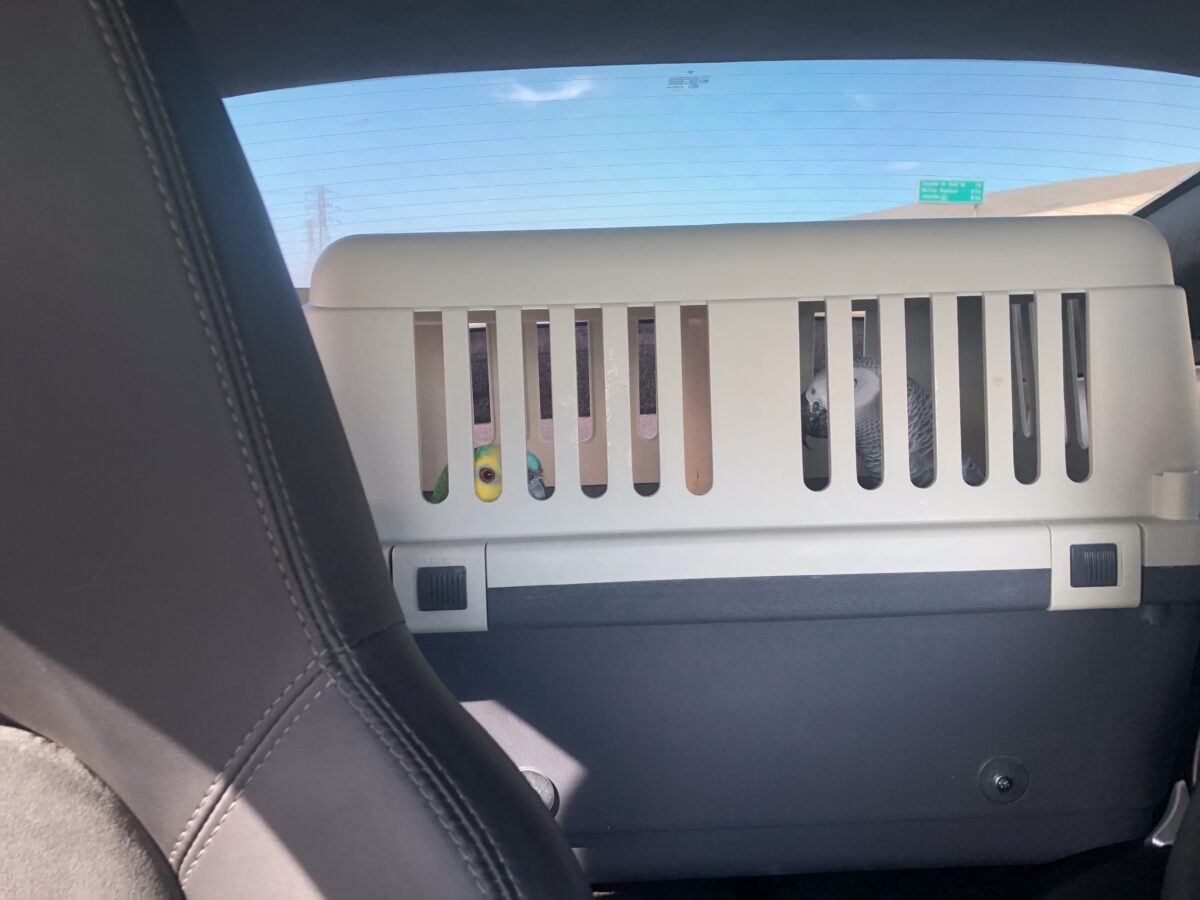
The carrier was basic and more like a prison cell, but was mostly successful. The drive home after purchase was a bit more exciting–while Agent Smith drove Midge north, it was just me and the boys in the Carrera for many hours. and needless to say, by the time we got home they were pretty pooped. They were more than happy to sleep in the next morning, so we got to sleep in as well.
Since February, the rest of the world has obviously changed over to our normal shelter-in-place lifestyle, and we’ve used the time to get Midge ready for use. This process involved lots and lots of cleaning, mainly to get rid of the overpowering smell of sandalwood, and the grime created by the previous owners’ small child who apparently made lots of small messes. Agent Smith replaced the cab stereo head unit and redid much of the wiring for the audio, and the optics for the rear view camera. We had our Ford techs at Mission Valley Ford handle replacing the brakes which were, well, awful.
This is what the inside of Midge looks like. As you can see, she’s a pretty compact beastie. Built atop a Ford 550 truck, the cab comfortably seats four. She has a full kitchen, bathroom, and tons of storage space in the back section, and a king-sized bed with decent headroom above the cab. Her exterior boasts even more storage, and there are solar panels on her roof to power both battery setups.
We picked up a couple of travel cages for the boys, and they fit nicely across the collapsed passenger seats. I had some new cushions made that, while not perfect fits, are much better than the vinyl ones she came with, although we’re keeping the vinyl as they’ll be useful for when Midge is off to the races.


We did some light shopping at Pyrex.com and Corelle.com a few months back and picked up some dishes, knives, utensils and spare storage bowls. The dishes are prone to rattling about in Midge’s storage cabinets, so I took some spare headliner material left over from a Mini project and whipped up some nice storage envelopes for them. They fit nicely in one of the cubbies above the sink.
Here are the sleeves in action: https://www.instagram.com/p/CENp_uSHbN3/?utm_source=ig_web_copy_link
Anyway, since California is on fire, Midge is currently sitting in the courtyard, packed and ready to go. Our area was placed under an evacuation warning and then evacuation order late last week. We left, but returned once things looked safer per the reports and maps, as the evacuation orders were pretty broad. While portions of the fire did make it into the valley east of us, CalFire had by Sunday managed to stomp it down through a combination of dozer lines and retardant drops. Add to this the predicted second lightning storm was minimal, and everything up here survived without issue–at least in this instance.
Here’s a tweet from San Jose Fire’s twitter feed of what lies behind us:
#SCULightningComplex fire threat to #SanJose is currently minimal. The line on the western side of the fire on our city border is well enforced. We’ll continue to monitor the situation and encourage residents to be ready for changing conditions. Follow @calfireSCU for updates. pic.twitter.com/zcRSuGN83u
— San Jose Fire Dept. (@SJFD) August 25, 2020
The pic on the left shows the lake at Grant Ranch, in the valley on the other side of the small mountain we live upon. The area behind it is all burned; it should look much like the foreground.
And here’s a satellite image from yesterday showing the same area from above. The white dots are Lick Observatory and you can just see the green oval of the lake at Grant Ranch on the left. All that misty white stuff across the image? That’s smoke from the embers burning themselves out. The dark brown areas? They should look like the bottom left area of this image, but no longer do because fire.
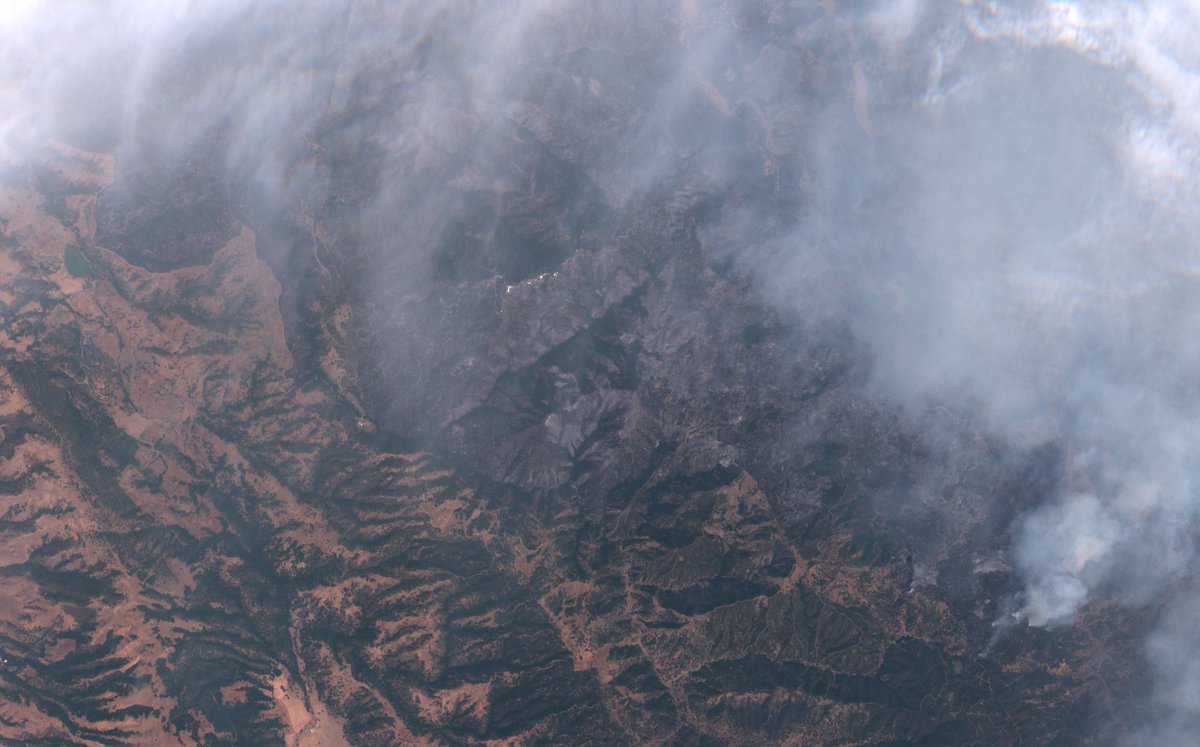
The Lick was the one point amidst the 360,000+ acres of land that burned where much effort went into keeping it intact. While the crew from San Luis Obispo stationed up there did lose one of the staff housing units, the telescope domes and visitor center survived the night, but it was not an easy job. Here is the video from HamCam2 during that really scary night.
Because the Diablo Range/East Foothills are primarily grasslands, just about everyone who lives up here adheres to weed abatement standards set by the county. That means if you don’t have livestock to graze the land, you mow and/or disc each spring to create fire breaks around all structures and across larger pastures. Two years ago we had a 40 acre grass fire that almost reached our south pasture. In the video below you can see how the grass just down from where the video was shot, and also down near the road, is all clear.
Because a lot of the vegetation on the west side of the range is abated/managed and we do not have the steep and deep canyons, fires on this side are somewhat easier to combat than near Mt. Hamilton.
While writing this post, the evacuation order was lifted, so life should start its return to some form of normal. Although the short time spent in Midge made us realize we needed a few extra comforts–a dedicated vacuum, a better way to keep the dishes secured (handled!), and containers to make better use of the long storage cupboard next to the bathroom. Still, we’re now ready for the next great escape.
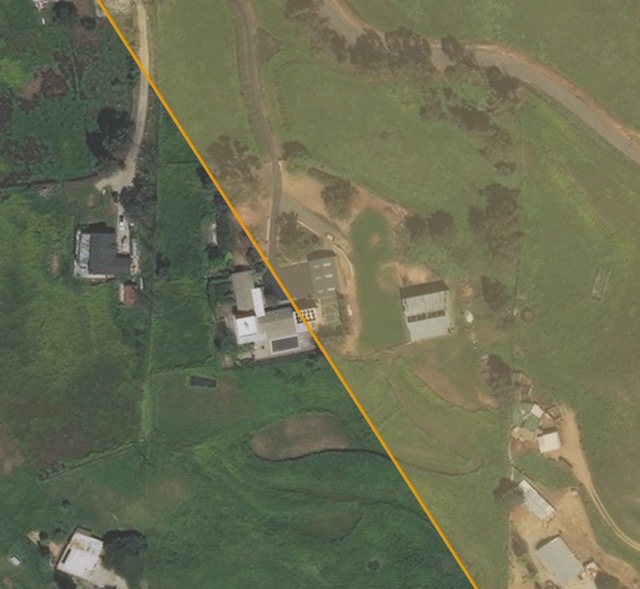
Addendum: I said that the lines for what areas were under evacuation warning or orders were broad, but they were also a tad confusing. When the first series of orders went out, we interpreted them to mean “don’t go to the garage, stables, or east side of the studio, but the main house is fine.” The agencies did get more organized as things went along, but this image is still amusing.
Nice winch!
Midge is a good wench with a winch in the front and winch in the back. The question then is which winch will winch best when Midge needs a winch?
Yarr fore and aft winches have ye. Avast ye one should be hanging from the mizzenmast. Oops talk like a pirate day has come and gone. The aft winch would work well for hauling a crippled car from a day at the track onto a flatbed trailer for the sad trip home. The fore winch is most useful for pulling somebody back on the road yourself included. Great for moving that tree truck blocking the road. Could pull down offensive statuary with it. Having 2 is certainly a luxury.